
Creating a business growth strategy is critical to the long term success of any business.
Providing a blueprint to survival, a mapped out growth strategy helps to drive revenue, increase performance and provide a vision for your business to strive for.
Achieving business growth is the aim of every company, but not every owner documents their goals and creates a clear pathway to achieving them.
Having this plan defines where the company is, where it wants to be and sets out the clear actions needed to get there.
It’s particularly impactful if you’ve recently lost clients, are low on sales or if there has been an increase in competition within your industry.
To put things simply, if you don’t have a clear plan for 2023 and beyond, then you’re missing out on opportunities to improve your business.

Business Growth Strategy vs Marketing Strategy – What’s the Difference?
Let’s clear up a common misconception before we dive in, as this is often a topic of confusion for start-up companies.
A business growth strategy is a roadmap for achieving sustainable growth over time. It generally covers 12-24 months and helps companies identify their strengths and weaknesses, develop new strategies, and implement them effectively.
Business growth strategies are essential for businesses because they provide direction and focus. They also help companies stay competitive and adapt to changing markets.
It’s important to note that a business growth strategy is different to a marketing strategy.
Think of it like this, a business growth strategy is the bigger picture, involving the direction of each and every department in the company, such as sales revenue, employees etc.
On the other hand, a marketing strategy analyses the specific tactics needed to assist the overarching growth strategy for your business, dealing with things such as PPC campaigns and public relations.
What to Include in a Business Growth Plan
Whether you are a start-up, scale-up or enterprise company, you should begin your business growth plan by doing the following:
Conduct a SWOT analysis
In order to manage change effectively and make strategic decisions, it is essential that businesses understand the strengths, weaknesses, opportunities and threats facing their company.
More importantly, businesses must assess these areas in relation to their overall strategy.
A SWOT analysis helps you to assess the current situation. What are the strengths, weaknesses, threats and opportunities currently facing your business?
Strengths – Are there things going well right now? Where does the business excel? Can anything be improved? Why do clients buy from you – if you don’t know, ask them!
Weaknesses – Is there anything missing? Could anything be added?
Threats– Has something changed recently that could affect the business negatively? Will the economic slowdown affect your revenue? Is there any future legislation that will impact your business?
Opportunities – Do you have any unique features or technologies that could benefit your business?

Define the Goals of Your Organisation
Defining the goals of your organisation helps you understand exactly what you’re trying to achieve when you write your business plan. These goals tend to fall into two categories: short-term and long-term.
Your short-term goals could include things like increasing website traffic, hiring staff members, or creating new products and services.
Your long-term goals are broader objectives that may require longer timelines. For instance, a goal like “expanding our customer base to a new country or region” could span anywhere from a few months to several years.
Target a Specific Area of Business Growth
Deciding you want to grow your business is the first step.
Next, you need to define exactly which area you wish to kickstart that growth.
There are several different areas of growth to consider including team expansion, increased office space, broader lead generation approach, new service introduction, revenue increase or enhanced sales conversion rate.
Typically, improving one target area will create a snowball effect within your organisation, but it’s easier to streamline your strategy to make it as specific as possible.
Your strategy can also be broken down into two different areas, internal and external.
An internal strategy focuses on how to best use the tools you already have at your disposal.
Are there ways of making your internal team more productive? Are there ways you can reduce your expenditure whilst retaining your output?
An external strategy involves looking at ways you can invest to kickstart business growth.
Perhaps you could introduce a new service, offering it to both new and existing customers. Or, you may want to consider outsourcing or investing in new technology.

Write Down Specific Actions You Think Will Lead Toward Success
After defining your specific goals and targeted area of growth, you can now turn your attention to writing your detailed action plan.
Each strategy you choose to pursue should serve as part of a larger whole. As a result, it’s helpful to think broadly about the various approaches you could take to achieving your goals.
For example, let’s say you want to increase revenue.
One approach might involve selling more products directly to consumers. Another might mean opening a retail store. And still another might entail starting an ecommerce site.
All of these options are valid; however, only one will likely prove successful.
So, before deciding on how to proceed, evaluate all the different paths you’d consider taking towards your overall goal. Do some research so you can narrow down the possibilities and identify which ones make the most sense for your business.
Tried and Tested Business Growth Strategy Examples
If you want your growth map to point you in the right direction, it’s helpful to analyse what methods have proven successful over time.
Here, we’ve assembled an overview of some of the tried and tested business growth plans you can use to expand your company:
Market Penetration
Market penetration is a low risk strategy ideal for start-up companies or those without the financial capability of heavy investment.
You can start by working out the total addressable market. According to GoCardless, market penetration rates can be anywhere between 10% and 40%, depending on the size, score and nature of your business.
The aim is to improve your market share by increasing your presence within your existing market. This means finding ways to beat the competition by repositioning your current offering.
A quickfire method of market penetration is to alter your pricing to tempt clients away from your competitors.
Other methods include becoming more aggressive with your marketing campaigns, offering to go into partnership with established competitors or altering your service to align with the needs of the market.
If you have the capital to do so, you could even acquire competitors for instant growth and market domination.

Market Development
Instead of trying to grow within your current market landscape, it may be time to branch out.
Market development may be the best course of action if you feel your business is experiencing a plateau or you have already exhausted all avenues of growth within your existing marketplace.
Often, this repositioning can be done by expanding into new territory geographically, either nationally or internationally.
This often takes a lot of research and expertise, with many things to consider before jumping in, such as making alterations to your service, assessing the resources you have available to make it happen etc.
Uber is a great example to consider.
What started as a small business based in the San Francisco area of North America has now expanded into a global business spanning over 10,000 cities.
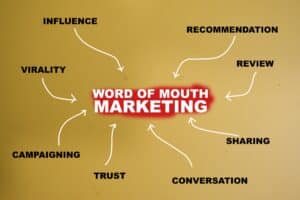
Word of Mouth
How often do you actually invest time and resources into improving the word of mouth for your business?
According to Semrush, 90% of people are much more likely to trust a recommended brand (even from strangers)
That’s why utilising your end users to get the best out of them is a great place to start.
The aim should be to turn your existing customers into advocates for your business.
There are a few ways you can do this, such as creating engaging video testimonials and asking for referrals, but one great way to promote advocacy is to introduce a ‘viral loop’ for your service.
This method works by offering an incentive for a client to recommend your brand to others in their network, such as giving them a discount on a secondary service you have.
Make this incentive enticing enough, and the process should continue effortlessly, allowing your clients to do some of your marketing for you!
The beauty of this method is it flips the sales funnel on its head. Instead of needing many leads for just one client, you now only need one client for many more.
Sales Enhancement
Sales revenue is the most fundamental marker to your company becoming more profitable.
No other department within your business has more of an impact on your company’s development than your sales team.
Your sales team is a completely different facet of your business that requires specialist implementation to accrue regular new business.
Improving your bottom line may be as simple as investing in SDRs, recruiting more experienced sales leaders or outsourcing to specialists directly.
Ask for Help
To implement new business growth strategies, you will need to free up as much time as possible to make your growth plans a reality.
That’s why outsourcing your business growth can provide you with more time, more expertise and more access to cutting edge technology.
At Excelerate360, our mission is to help as many businesses as we can to achieve their full potential by implementing proven sales strategies and speeding up business growth.
If you need help getting your business performance into shape, then give us a call and we’ll help you to execute your very own business growth plan for 2023.
