
Navigating the key stages of business growth is like growing a tree.
At the start-up stage, you carefully select the right soil and location, plant the seed, and provide it with the necessary nutrients and water to help it grow. This stage of your business requires careful planning, hard work, and perseverance to establish itself in the marketplace.
As the business begins to take hold and grow, it enters the grow-up stage. You continue to nurture your tree, providing it with regular care and attention, ensuring that it receives adequate sunlight and water. Here, you need to refine your business’ operations, expand its customer base, and increase its revenue and profitability.
Once your business has established a solid foundation and a loyal customer base, it may be ready to enter the scale-up stage. Your tree is now bearing fruit. With the right tools and resources, you can reap the rewards of your hard work and investment, enjoying a bountiful harvest.
Scale-up successfully and you can enjoy significant growth and profitability, often expanding into new markets and reaching new heights of success. Just as a successful harvest requires careful planning and execution, scaling up a business requires strategic thinking, strong leadership, and effective resource allocation.
Now that’s enough about trees and fruit.
Let’s unpack each stage of business growth (start-up, grow up and scale-up) to show you how you can handle them effectively to enjoy sustainable progression.

1) Start-up Phase
For business owners, the start-up phase of a company can be immensely exciting, but it comes with a fair share of challenges too.
That’s because you will typically be bootstrapped financially, having to scrutinise every spending decision to work within your tight budget.
This is also the period where your business is most under threat, as research shows 20% of small businesses fail in their first year and around 60% of small businesses fail within the first three years.
Working with financial constraints makes talent acquisition all the more difficult, meaning you should prioritise hiring talented individuals with diverse skill sets who can contribute to the growth of your company.
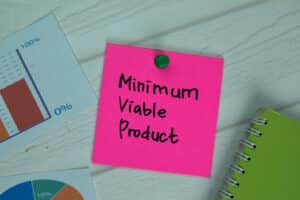
One of the biggest challenges of the start-up phase, especially in the SaaS space, is the need to create a product or service that meets customer needs while staying within your budget. This is where the concept of a Minimum Viable Product (MVP) comes in.

Creating a Minimum Viable Product
An MVP is the simplest version of your product that can be launched to the market with just enough features to meet the needs of your target clients.
By launching an MVP, start-ups can get feedback from customers and iterate their product based on the feedback received. It saves time and resources, allowing you to speedily get your product to market.
Start-ups that create an MVP are much more likely to survive, as 29% of start-ups fail because they run out of money, according to a study from CBinsights.
However, creating an MVP comes with its own challenges.
Start-ups must balance the need for speed with the need to create a high-quality product. In addition, it can be difficult to determine which features to include in your MVP, and which ones to leave out.
Therefore, a lot of experimentation is needed as you test and refine your offering.
Entering the Market
To enter the market effectively, start-up companies will need to ensure they have a business model that includes high levels of strategic planning.
During this early stage of development, having a well-defined business plan that outlines your goals and objectives will not only ultimately help attract investors, but sets a clear direction for your company.
It’s also highly likely, as an owner, you will still be highly involved in the sales cycle. This is not necessarily a bad thing to start off with, as it will help you learn the wants and needs of your customers first hand.
Your personal reputation and network of the CEO will be critical in getting new deals over the line.
Networking and building relationships within the industry is fundamental for start-ups as you seek funding, partnerships, and mentorship from experienced professionals.
To gain a footing in the market, you need to create a solid strategy, utilise your network and remain adaptable as you change to meet the needs of your customers.
Once you have tested your service and exhausted all personal contacts, it’s time to enter the cold world of lead generation, and fight to establish your company’s place in the market.
We call this the grow-up phase.

2) Grow-up Phase
The grow-up phase of a business is where things start to get real.
Your initial phase of experimentation and planning is over, now it is time to drive home results.
To do this, you will need to nail down your product functionality to make it flawless, and really hone your messaging to speak directly to your target customers. This won’t work unless you truly know and understand who your ideal customer is, what their pain points are, and how your service aligns with their wants and needs.
So, step one of growing up is to define your ideal customer profile (ICP), and craft messaging that makes them sit up and take notice.
Targeting your Ideal Customer Profile
To begin, it’s essential to have a clear understanding of your product or service and the problem it solves for your customers.
Conducting market research, creating buyer personas, and analysing customer behaviour data can help you determine who your ideal customer is and what they are looking for.
Once you have identified your ICP, you can then build a list of contacts who match this profile, then create targeted marketing campaigns, personalised messaging, and lead generation strategies that resonate with their needs and preferences.
Ensure your messaging showcases the unique value your company offers, and speaks directly to your ideal customer’s unique challenges and aspirations. In other words, your job is to sell them their dream.
Remember to keep this messaging consistent across all channels, including your website, social media, email marketing, and advertising.
Great messaging can increase engagement, drive conversions and contribute to your business establishing itself within the marketplace.

Using Metrics to Measure Market Success
While planning is fundamental to your success, ‘growing up’ means you are now in the results business.
Emotions won’t pay wages, so you need to define what success means for your business in the marketplace, and consistently measure your performance to work out ways you can improve.
Engaging with your customers through social media, email marketing, and other communication channels can provide valuable insights and a feedback loop, which can be used to refine and improve your approach.
One way to plot market success is to create a sales funnel of metrics that tracks the customer journey from initial awareness right through to purchase.
This funnel can include metrics such as website visits, social media engagement, volume of leads, conversion rates, and customer retention. By measuring each stage of the funnel, you can then adjust your marketing and sales strategies accordingly.
Once you have evidence your target market is responding well to your product, and you are experiencing rapid growth, it may be time to consider how you are going to scale your business operations.

3) Scale-up Phase
Once you have built your product, tested its functionality, built a strong brand identity and established a presence within the market, it may be time to amplify your business growth by scaling up.
But when is the right time to scale your business?
It’s important to assess whether your business is ready to take on the challenges of significant growth.
Some key performance indicators that your business may be ready to scale up include consistent revenue growth, a proven product or service and a clear understanding of your target market.
To enhance your business efforts on a large scale, you may need to find financial backing for your business. If you are, then you will need to present a compelling picture based on solid data.
Leveraging Predictable Revenue to Scale Up
As renowned sales strategist Aaron Ross details in his book, ‘Predictable Revenue’, “One-time revenue spikes that aren’t repeatable won’t help you achieve consistent year-after-year growth.”
That’s why, he says, the holy grail of growing a business is to have predictable, repeatable, and scalable revenue.
Aaron Ross’ advice is that you should develop a system where you can say to investors ‘if I had one more salesperson, they can perform x activity, that will yield y results.’
That way, you can forecast your cash flows and grow your business with investment. Without this robust process, you have no idea how much business one salesperson can bring in, or how long it will take.
If you don’t know this information yourself, how are you going to convince investors what it will take to provide them with a profitable return?
This is where your metrics from the ‘grow up’ stage come in handy.
You can use your data to analyse your lead generation efforts. Find out how many emails, phone calls, and touchpoints it takes for one salesperson to convert a new customer.
At Excelerate360, we generate new business for our clients effectively by compartmentalising the sales team. Business development executives identify and qualify leads, before the account executives close.
This way, you can assign specialists at each end of the sales cycle, and separate accountability across the board. By documenting the entirety of this process, you can create a repeatable system for new salespeople to adhere to, and it makes it much simpler to evidence to investors your company is ready to take the next step.

Planting the Seeds of Business Success
Whether your business is still sprouting its roots, or its already bearing fruit, the most important aspect for continued growth is your sales department.
Sales, after all, are the ultimate source of revenue generation for your company and will be the deciding factor when it comes to excelling in a competitive market.
So, if you’re a start-up looking to find your feet within a marketplace, an enterprise company hoping to assert your presence and messaging, or an established business planning a large scale up, you’re in the right place.
At Excelerate360 we help businesses achieve their goals by alleviating the pressure of expenditure, time and internal infrastructure to accelerate consistent sales growth.
Just like we have done successfully so many times before.
Contact us today to learn more!
